
Sample 12 ODE
SYSTEM(RUN=1)
DLG(TItle='Ordinary Differential Equations', E='#Describe', B='OK')
SET($nr=1, $type="y'=5*t^4", t=0, x=0, steps=20, $xmin=0, $xmax=5, resultLines=0,dtFMT=" ")
radio = ("y'=5*t^4", "y'+y=SIN(t)", "y'+x*y=x*y^2", "y'=y*x^2/(1+x^3)")

DO
    $nr = INDEX(radio, $type, 'Array')
    SET(y0=(1,1), y=(1,1), dy=(1,1), $result=(1,3))
    IF($nr == 1)
        y0(1) = $xmin^5
    ELSEIF($nr == 2)
        y0(1) = (EXP(0-$xmin) + SIN($xmin) - COS($xmin)) / 2
    ELSEIF($nr == 3)
        y0(1) = 1/(EXP($xmin^2/2) + 1)
    ELSEIF($nr == 4)
        y0(1) = (4*(1+$xmin^3)) ^ (1/3)
    ENDIF
    TIME(SECondssince = t0)
    ODE(y0, $xmin, $xmax, steps, 'f0(t, y, dy, $result)')
    dTime = TIME(SECondssince=t0)
    dtFmt = FMT(dTime, 'F3') && 'seconds to execute'
    resultLines = INT(LEN($result))
    Graphics(dtFmt)
    DLG(BG=90, TI=radio($nr), RAD=radio,Val=$type, B='OK', NE=y0(1),SYM, NE=steps,SYM, NE=$xmin,SYM, NE=$xmax,SYM, LBL=dtFMT,SYM, LBL=resultLines,SYM, B='Cancel', B='Cancel')
    ARRAY(Name=$result, CLeaR=1)
ENDDO
ENDDO
END

FUNCTION f0(t, y, dy, $result)
    IF($nr == 1)
        dy(1) =  5*t^4
    ELSEIF($nr == 2)
        dy(1) = SIN(t) - y(1)
    ELSEIF($nr == 3)
        dy(1) = t*y(1)*(y(1) - 1)
    ELSEIF($nr == 4)
        dy(1) =  y(1)*t^2/(1+t^3)
    ENDIF
END

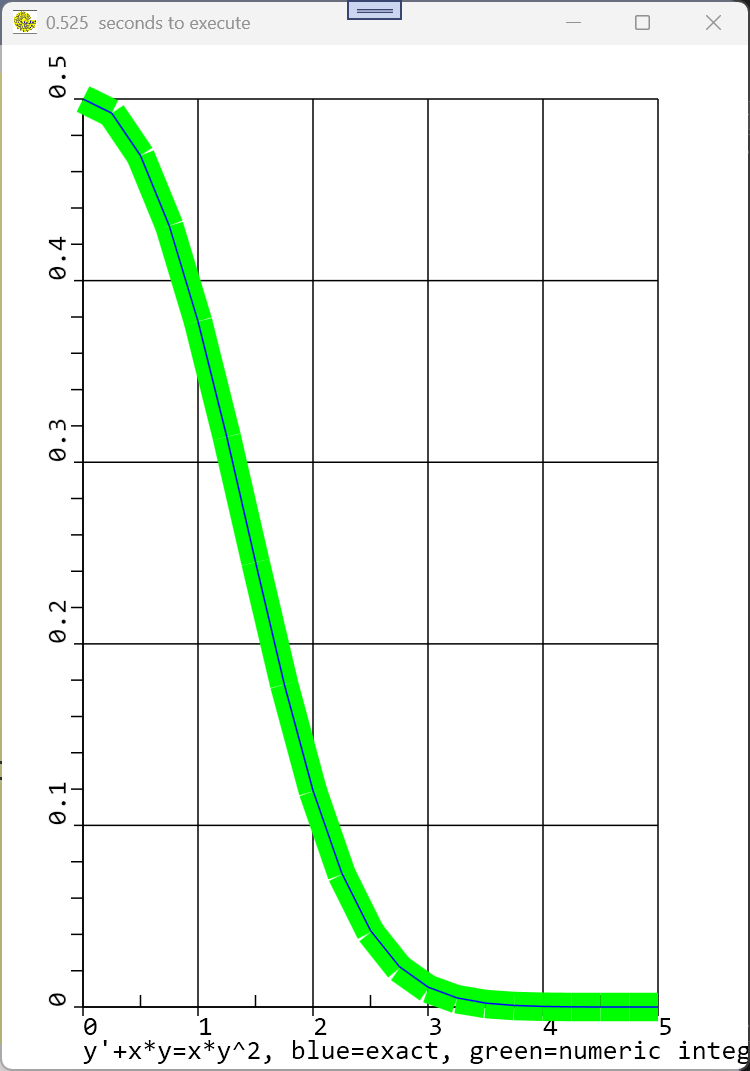
FUNCTION Graphics(dt)
    xTitle = $type & ', blue=exact, green=numeric integration'
    DO i = 1, LEN($result)
        t = $result(i,1)
        IF($nr == 1)
            $result(i,3) = t^5
        ELSEIF($nr == 2)			 	! y=cEXP(-x)+(SIN(x)-COS(x))/2   y=0 @ x=0 => c=1/2
            $result(i,3) = (EXP(-t) + SIN(t) - COS(t)) / 2
        ELSEIF($nr == 3)  				! y=2 @ t=1
            $result(i,3) = 1/(EXP(t^2/2) + 1)
        ELSEIF($nr == 4) !  y^3 = 4(1+x^3)
            $result(i,3) = (4*(1+t^3)) ^ (1/3)
        ENDIF
    ENDDO
    SEt(yMin=1E100, yMax=-1E100)
    DO i = 1, LEN($result)
        yMin = MIN(ymin, $result(i,2), $result(i,3))
        IF((yMax > 1E100) + (ymin < -1E100))
            MSG(T='Will run beyond limits :||increase steps,|and/or|decrease tmax||for this problem', B='OK')
            EXIT
        ENDIF
        yMax = MAX(yMax, $result(i,2), $result(i,3))
    ENDDO
    DLG(L=0.6,H=1,T=0,W=0.4, TI=dt, AX=3, TI=xTitle, MIN=$xmin, MAX=$xmax, Y=1, MIN=yMin, Max=yMax)
    LINE(AX=3, Column=1, Zeros=1, XVEC=$result, Col=2, YVEC=$result, Width=19, Draw=90)
    LINE(AX=3, Column=1, Zeros=1, XVEC=$result, Col=3, YVEC=$result, Width=1,  Draw=9)
END